Monday, July 9, 2018

Jupiter: Giant of the Solar System


Jupiter is half a billion miles away from the Sun. It is a giant sphere of gases. Jupiter has the most exotic weather pattern we have ever seen in our solar system. It is 84 percent Hydrogen and 14 percent Helium which are the two lightest and most abundant elements in the universe and those are rolled into a mammoth mass. It is 11 times the diameter of the earth. No doubt that it is the largest planet in our solar system which is visible to the naked eye. A day is only 9.9 hours long and it takes 11.8 years to orbit the sun. A 150lbs person will weigh 350lbs on Jupiter. There are thunders clouds made of ammonia, Sulphur, and water. Its electromagnetic radiation is intense that it would kill a traveler to the planet.


How it was born??


Some scientists believe that it may have been a star but failed at the start. Like the sun, it had right ingredients hydrogen and helium but not enough mass to create internal pressure and temperature necessary to create nuclear fusion. So, it became a planet instead. The thought is that Jupiter spinning gases attracted the light elements and grew bigger and bigger. What gases it didn’t take, it spat out in the space. So what it does is, it cleans up the path in the solar system, many planets revolve safely in the space.

Jupiter’s power play:

In July 1994, a comet called the Shoemaker Levi 9, approached towards Jupiter. Once under Jupiter’s gravity, there was no turning back. When it was going to crash, Jupiter’s massive gravitational pull broke the comet into smaller pieces that came in one at a time. These pieces assaulted the planet at a speed of 37 miles per hour. If we take Jupiter out of the picture then that comet might have hit anywhere, might be earth.


Fig.1.1 Broken pieces of Shoemaker Comet hitting the Jupiter.

In 1665, Jupiter’s most fascinating feature was discovered and that is its giant Red Eye which is actually the eye of an enormous storm. It is 12,000 miles wide. It is faster at the edges but calms at the center and it is never-ending. But if there’s no ocean or water there then what’s keeping it going. That is still a mystery.

Fig.1.2 Jupiter’s Red Eye.

Jupiter’s mysteries aren’t limited to the planet itself. Some of its most intriguing elements are circling around it. It’s got several dozens of moons that are big enough to be seen. You can say that Jupiter has its own solar system. And each moon holds its own fascination. Four of them were discovered by Galileo. The first major moon that comes is IO which is a very active place with volcanoes. It has about a hundred volcanoes and some of them are of the size of California. The second is Ganymede which is the largest moon of our solar system. It is 5 times the size of our moon. Callisto is the most heavily crated. And Europa, the ice queen to the Jupiter’s king. No one knows it’s make-up for sure. And scientists are very convinced that there’s water deep under the hard icy surface on the crust. And then the presence of water leads to shaking the question that is we may not be alone.


Fig.1.3. Jupiter’s 4 moons 1. IO 2. Ganymede 3. Callisto 4. Europa.


Above all:


Above of all Jupiter’s imposing features, none is more impressive than the one we cannot see. It’s a bubble buzzing with electrically charged particles. It’s Jupiter’s magnetic sphere. It is the biggest entity in the Solar System. There’s a rounded section faced away from the planet in one direction with a tail flowing out the other direction. This reaches the outer orbit of Saturn. It’s like a monster and it roars also even we can listen to it. If you are driving a dark desert highway, your radio might just tune in to a strange sound of magnetic sphere.

Fig.1.4 Jupiter’s Magnetosphere.


One surprise came in 1979 when it was discovered that Jupiter has a ring, it’s nothing in the order of Saturn. It comes from the material being knocked off from the moons i.e. it’s the collection of dust from the moons.

Fig.1.5 Ring of Jupiter.


There are still many secrets that are still unrevealed by the Jupiter like what causes the Red Eye to keep going and many more. Answering these questions may lead us to other secrets of the planet. But that is a good thing because life without questions will be boring.


Sunday, July 1, 2018

Black Holes and Fundamental Laws of Physics

Black holes are structures in the fabric of space and time itself. And there are many such objects in the universe. Despite the mathematical complexity of describing black holes and various ways in which it forms, we also know that they possess a very striking simplicity.

In 2005, black holes were identified by the gravitational waves released from the collision of two massive black holes orbiting each other. In 1687, Sir Isaac Newton described the law of gravity, by observing an apple falling from the tree and then he observed that every falling object behaves in the same way.

Fig.n. Newton’s Diagram of a Planet with a mountain on it.


In the above figure drawn by Newton, there’s a planet with a tall mountain on it and imagine that you’re throwing a ball from point V with a lower velocity, it will fall on D having a lower distance from V. And as the velocity of throwing the ball is increased, it will fall farther from point D, say on E. And if you’re able to throw the ball with a velocity of 7.9km/sec, then the object will keep falling and returns to the initial point. He explained that the moon and other celestial bodies orbiting the earth are objects that are actually falling.

Fig.n. Explaining Gravity is not a force


The next chapter began in 1905, Einstein proposed the theory of relativity. The main aspect of this theory was that “The universe has a speed limit” which is about 3000km/sec which is the speed of light. In 1915, the proposed general relativity, in which he described that Gravity is NOT a Force. Gravity is the manifestation of curvature in space-time. It implied that matter curves space-time and space-time curved forms how matter moves. After the Einstein’s discovery first black hole was found. A black hole is a matter in space-time in which once you go inside the black hole, you can never escape. The boundary of a black hole is called Event Horizon. Now suppose you are driving a spaceship towards a black hole and after crossing the event horizon, no matter how much force you apply, you can’t escape. Similarly, if you light a torch from inside the black hole, the light will remain inside it as shown in the figure below.

Fig.n. Figure showing the event horizon of a black hole.


The concept of black holes started from the evolution of stars. Inside the star, there are two forces acting that is gravity which is pulling everything inside and the pressure which is pushing everything outside and both of these forces are in equilibrium. But as the fuel inside the star i.e. the nuclear fuel is exhausted and if the star is big enough, the star will compress and explode to form a supernova. And then there will be the core of the star that will keep collapsing in or out it and forms a black hole. Despite the complexity of formation of black holes, the final black hole that is created is specified by two numbers:
  • ·         It’s Mass
  • ·         It’s Spin.

Well precisely there are 3 numbers; the third one is the Electric charge. But it can be neglected as it is very small.
Fig.n. Black hole sucking matter from a star.


If black holes are black, how do we detect them? In the given figure, there’s a black hole and a star. And the black hole is spinning and you can see that it is continuing to strip off the matter from the star. And as it strips off the matter, and because the black hole is rotating, that matter gets swirl around the black hole and heats up and forms the plasma. These plasmas reach a very high temperature and start to emit X-rays. The first indirect attention of black holes came from measuring X-rays produced by black holes as in this picture. Through this approach, now we know that there are many black holes in the Universe and there’s also a massive black hole inside the Milky Way galaxy weighing 3 or 4 million times that of our Sun.
Now, let’s discuss the direct way. In 1916, general relativity predicts gravitational waves traveling at the spent of light. It says that when a matter moves through space-time, it produces gravitational waves. Similarly, the earth also releases gravitational waves, while orbiting the sun. But gravitational waves are small as gravitational forces are weak forces. Now, imagine two black holes are orbiting each other as shown in the figure below. 

Fig.n. Black holes orbiting each other.


And while orbiting they are emitting gravitational waves which are not very strong. But as they approach near to each other, the strain increases and then a stage comes when there is a merger and at that time the strain is the strongest. During the merger, the larger gravitational waves are generated. And after the merging of two black holes, a single one is formed where the strain becomes zero as shown in the figure below. The variation of strain in gravitational waves gives the idea about the presence of black holes in the Universe.

Fig.n. Graph showing variation in strain during merging of two black holes.


Until now we have found many black holes in the Universe but there are many more to be discovered. And still there’s one question which is unanswered and the question is that whether the black holes will bring nightmares for the Universe or they will lead us to some astonishing secrets of the Universe.


Monday, June 4, 2018

Dark Matter and Dark Energy


Science is about predictions, making predictions and testing predictions. We don’t know what is going to happen to all the planets of the solar system. There might be a chance that one day some planet may collapse or two planets may collide or some explosion on Pluto will destroy the earth. Well the last one seems very much impossible but other two may be possible. We know that our solar system is stable since some billion years. But beyond that we genuinely don’t know. And the Sun, we think it will last 5 billion years. So it’s fair to say that we don’t have any idea that whether the solar system is actually stable. And that raise many questions about the past of the universe or its future.

And also things like “dark matter” or “dark energy”. Inside our solar system, as we know that the Sun pulls the planets and prevents them to fly away. This gravity is also pulling the planets towards each other. If you look up at the dark sky with your naked eyes, you may see many stars. But if you see the same portion of the sky with a powerful telescope, you will see many bright objects there. Are these all stars? For .e.g. if you look at the “Andromeda” constellation, then as well as stars you might see a faint mere of light and that faint mere of light is nothing but the another galaxy which is called “Andromeda” galaxy and that has also millions and billions of stars. Now if you’ve given a telescope let’s say “Hubble Space” telescope and asked to take the pictures of the blank sky. That will be impossible because every time you’ll find millions of galaxies and billions of stars in that picture even in the one tenth part of the sky. Now suppose we go to one the galaxies that you’ve seen through that telescope and we try to find how much stuff or matter are there in it. There are many ways:
Image result for andromeda galaxy 
Fig.n. Andromeda Galaxy

First method is that we will find “How bright is that galaxy?” and from that we will find “How many stars are there in that galaxy?” but there is another method. As we know that the galaxies are continuously spinning as the same way the earth is spinning. If we calculate “How fast is the galaxy spinning?” and from that we can calculate “How strong is its gravity?” and then we can find “How much stuff is there in it?” because gravity is possessed by only stuffs or objects. But practically these approaches give us the numbers far more different that the actual value. If we use the spinning method, we will end up with a number which is 5 times more than the number of matter that we can see. So there must be some matter which we can’t see but has mass. We named that matter “Dark matter”.
Image result for dark matter 
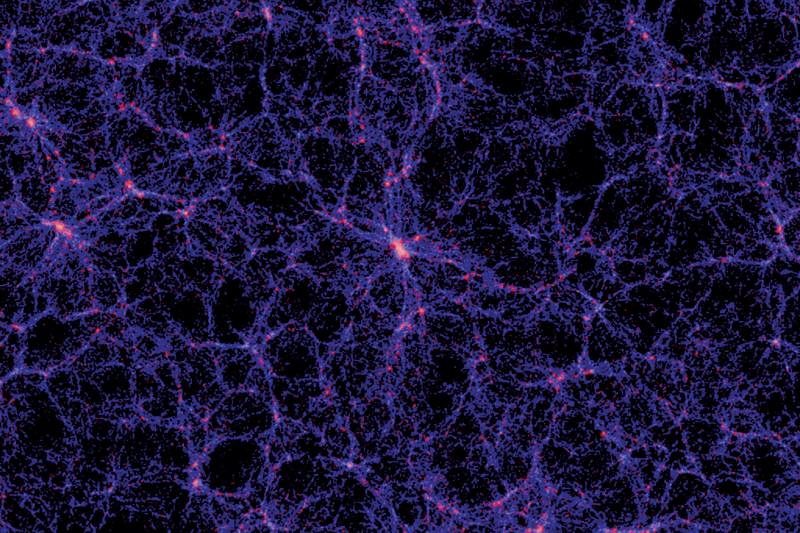
Fig.n. Dark Matter

In a cluster of galaxies, when many galaxies are very close to each other, the gravity becomes extremely strong which actually bends the light. And when we apply the above mentioned methods to find that how much stuff is there in the galaxy, like “How bright is it?” and from that we can calculate “How much stuff is there in it?” and then “How much the light is bend in those images?” and from that we can find out “Strength of the gravity?” and from that we can find out “How much stuff is there in it?”. And surprisingly we end up with a number which will be exactly same as mentioned above i.e. 5 times more. So these things convince us that dark matter does exist. But at the same time it also raises many questions. For e.g. “What is dark matter made of?” or “Where it comes from?"

We know that every matter is made of particles i.e. smallest elements that can’t further be divided into smaller chunks. Then we assume that dark matter is made up of particles too as it also a matter having some mass. Then we want to know how these particles behave? Now the main thing we know is about particles is that they feel forces. For instance, why a man is attracted towards the Earth i.e. because all the particles that are making him up are pulled down by the force of gravity possessed by the Earth. Now the question is why doesn’t the man sink into the floor? So there must be some another force acting on the man’s body acting opposite to the gravity. And that is electromagnetic force which is pushing him up. And electromagnetic force is also the reason that why we can see things e.g. light itself is the aspect of the force. Now if we talk about “dark matter”, they do have gravity but on the other hand we can’t see them. So that means that they don’t feel the force of electromagnetism.
Image result for electromagnetic waves in light
Fig.n. Electromagnetic Waves
 
Now the question is from where does these matters come from? Let’s try to find out how much dark matter is on the Earth. Now suppose that dark matter is coming towards the Earth, it’ll pass through the earth because it doesn’t feel
force of electromagnetism. So you can’t count them. But if somehow you freeze
the time and search all the dark matter, there will be around trillions of particles. But they are very tiny i.e. millionth of the millionth of the millionth of the kilogram. And now how can we find that particle which is of this size and invisible and untouchable. Dealing with the question that how on the Earth do we know that where these are coming from and from which direction. We can do this by using computers. Now suppose if we drop a blog of dark matter inside a virtual galaxy inside our computer (32-bit) and record the motion of that blog, we can see that as the gravity is strongest at the center of the galaxy, the dark matter moves towards it and gets thrown away outwards. It repeats the same actions in random direction. And every time the motion is unpredictable. And if we use a more powerful computer say 128 bit or more, it may give more accurate motion but it’s still unpredictable. So we can’t predict the exact motion of that blob but what we can do is we can predict the motion using the pattern formed by that blob i.e. by finding average.

Now what is “Dark Energy”? It is based on the following facts: 
Universe is expanding and we all know that i.e. all galaxies are getting further away from each other. Not only it’s expanding but it is expanding at an accelerating rate, and that is due to this energy called dark energy. It has a strange property i.e. it expands as the volume of space increases to keep its energy density constant. So as the universe expands, there will be more and more dark energy. So the future universe will be more and more dominated by dark energy and it will become colder.
Image result for dark energy 
Fig.n. Dark Energy
 
We still don’t know about the death of our solar system or the death of the universe because we can’t exactly predict. Like in the case of dark matter we reach for what we know about the particles and we came up with ideas and in the case of dark energy we did something similar i.e. we take ideas and we calculate average because it is all about patterns not specifics.